Understanding the ISA Deviation Without Memorising Tables
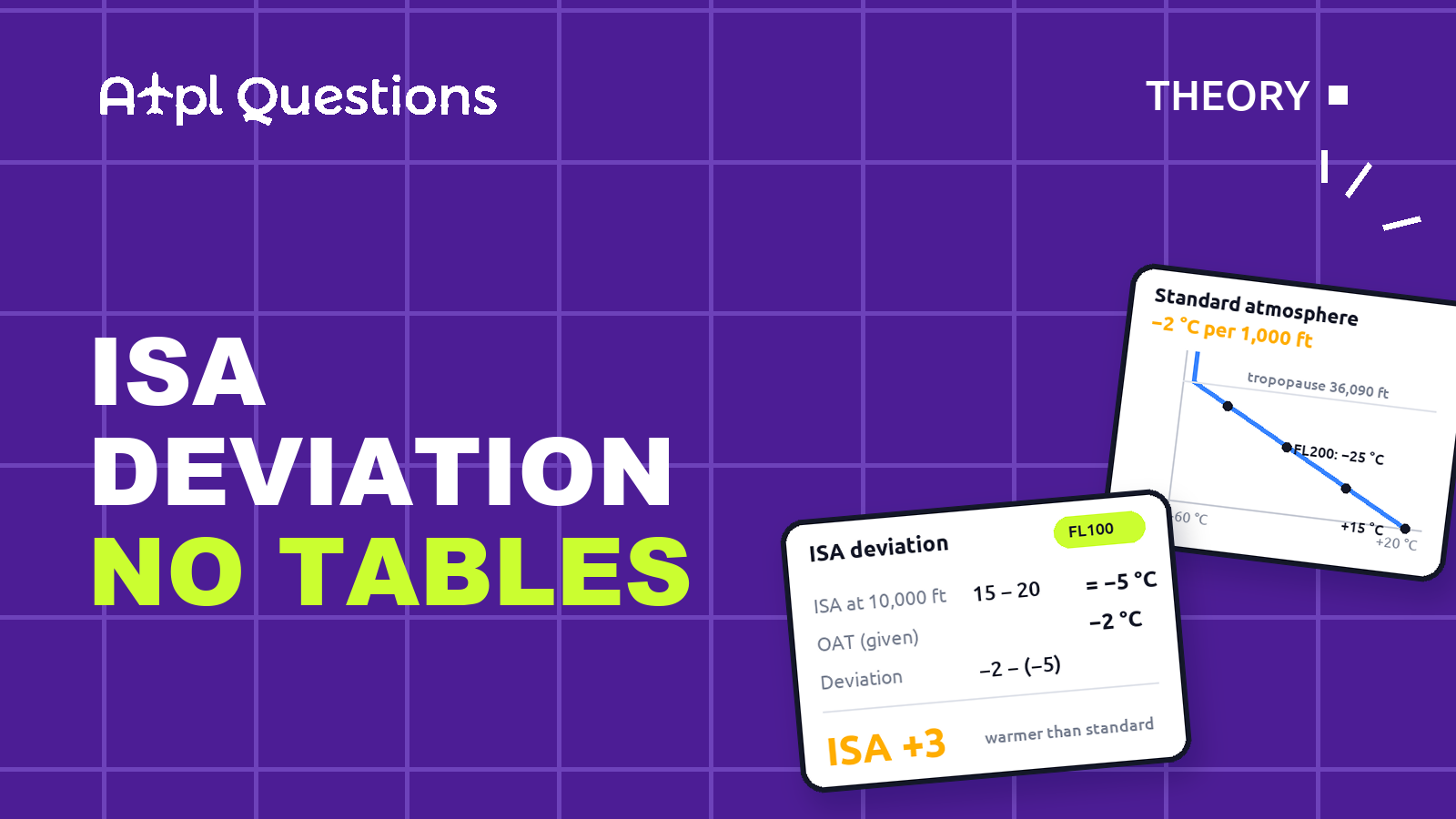
"ISA +10" appears in four different ATPL subjects, and in every one of them it is the same idea. Yet many students meet it as a table in Meteorology, a column heading in the Performance graphs, a correction factor in Instruments and a planning assumption in Flight Planning, and treat each one as a separate thing to memorise.
It is not. ISA deviation is one rule and one subtraction. Once you can do it in your head, the tables become something you check, not something you learn.
What the International Standard Atmosphere actually is
The real atmosphere changes every hour. Aircraft performance figures, altimeters and planning charts need a fixed reference to be comparable, so ICAO defined a standard atmosphere. At mean sea level (MSL) it assumes:
- Temperature: +15 °C
- Pressure: 1013.25 hPa (29.92 inHg)
- Density: 1.225 kg/m³
From there, temperature falls at a fixed lapse rate of 1.98 °C per 1,000 ft (6.5 °C per km) up to the tropopause at 36,090 ft (11 km), where it reaches −56.5 °C. Above that, in the lower stratosphere, ISA temperature stays constant at −56.5 °C up to about 65,600 ft (20 km).
For exam arithmetic, 1.98 is treated as 2 °C per 1,000 ft. That one rounding is what makes the whole topic mental maths.
The one rule
Up to the tropopause (36,090 ft):
ISA temperature (°C) = 15 − (2 × pressure altitude in thousands of feet)
ISA deviation = actual temperature (OAT) − ISA temperature
That is all of it. The deviation is positive (+) when the air is warmer than standard and negative (−) when it is colder, and the sign is what matters most in the exam.
Worked examples
- FL100, OAT −2 °C: ISA at 10,000 ft = 15 − 20 = −5 °C. Deviation = −2 − (−5) = ISA +3.
- FL180, OAT −30 °C: ISA at 18,000 ft = 15 − 36 = −21 °C. Deviation = −30 − (−21) = ISA −9.
- FL350, OAT −45 °C: ISA at 35,000 ft = 15 − 70 = −55 °C. Deviation = −45 − (−55) = ISA +10.
- Aerodrome at 2,000 ft pressure altitude, OAT +28 °C: ISA = 15 − 4 = +11 °C. Deviation = 28 − 11 = ISA +17. That is a hot-and-high day, and the performance chapter is about to care.
Watch the double negative in the second step. Students lose more marks to "−30 − (−21)" than to the lapse rate itself. Write the ISA temperature down first, then subtract.
Example question 1
At FL260 the outside air temperature is −44 °C. The ISA deviation is:
A) ISA −7
B) ISA +7
C) SA −8
D) ISA +8
Solution: ISA at 26,000 ft = 15 − (2 × 26) = −37 °C. Deviation = −44 − (−37) = −7 using 2 °C/1,000 ft. With the exact lapse rate (1.98), ISA = 15 − 51.48 = −36.48 °C and the deviation is −7.52, which the question bank rounds to ISA −8. If two options are a degree apart, the examiner used 1.98; otherwise 2 is safe.
Where the deviation turns up (and what it does there)
1. Performance: warm air is thin air
Every take-off, climb and landing chart is drawn for a range of temperatures, often labelled ISA, ISA +10, ISA +20. A positive deviation means lower density: less lift at any given true airspeed, less thrust, a longer take-off run, a lower climb gradient, and a higher true airspeed for the same indicated airspeed. When a chart uses ISA deviation and the question gives you an OAT and a pressure altitude, the first thing you do is convert it to an ISA deviation so you know which line of the chart you are on.
2. Density altitude
Density altitude is pressure altitude corrected for non-standard temperature, and the correction is driven by the deviation:
Density altitude ≈ pressure altitude + (120 × ISA deviation)
Aerodrome at 3,000 ft pressure altitude, ISA +15 → density altitude ≈ 3,000 + 1,800 = 4,800 ft. The aircraft performs as if it were taking off from 4,800 ft on a standard day.
3. True altitude: cold is low
Your altimeter assumes ISA. In colder-than-standard air the pressure levels are closer together, so the aircraft is lower than indicated. The rule of thumb is 4 ft per 1,000 ft of height above the pressure-setting datum (station elevation for QNH) for every degree of ISA deviation. Indicated 8,000 ft on QNH at an aerodrome at sea level, ISA −15: error ≈ 4 × 8 × 15 = 480 ft, meaning your true altitude is about 7,520 ft (480 ft lower than the altimeter says). That is why cold-temperature corrections exist on approach plates, and why "high to low, look out below" applies to temperature as much as pressure.
4. TAS, Mach and planning
The speed of sound depends only on temperature, so at a given Mach number a warm day gives a higher TAS; at a given TAS, a warm day gives a lower Mach. Flight planning tables give fuel and time at ISA and at ISA deviations, and the CAP 697 style questions expect you to pick the column from the deviation you calculated, not from the raw temperature.
Example question 2
An aerodrome is at 4,000 ft pressure altitude and the OAT is +22 °C. The density altitude is approximately:
A) 4,000 ft
B) 5,200 ft
C) 5,800 ft
D) 6,400 ft
Solution: ISA at 4,000 ft = 15 − 8 = +7 °C. Deviation = 22 − 7 = ISA +15. Density altitude ≈ 4,000 + (120 × 15) = 5,800 ft.
The three traps
- Mixing up ISA temperature and ISA deviation: "ISA at FL200" is −25 °C. "ISA +5 at FL200" is −20 °C. If a question says the temperature is "ISA +5", it is giving you the deviation and expects you to find the actual temperature, not the other way round.
- Forgetting the tropopause: Above 36,090 ft the ISA temperature does not keep falling. FL410 is still −56.5 °C in ISA, so an OAT of −50 °C there is ISA +6.5, not ISA +17.
- Pressure altitude vs. elevation: ISA temperature is defined against pressure altitude. If the QNH is not 1013 and the question gives you an elevation, convert to pressure altitude first (about 27 ft per hPa), then apply the rule.
How to practise it
You do not need a dedicated study session for this. Every time a Meteorology, Performance, Flight Planning or Instruments question gives you a temperature and a level, work out the deviation before you read the options, even if the question does not ask for it. After a week it is automatic, and the tables are just there for confirmation.
In the question bank, filter 050 Meteorology by the Atmosphere sub-subject and 032 Performance by the Take-off and Climb sub-subjects, and use the Stats tab on the questions you miss: a question the community gets right 85% of the time that you keep getting wrong is almost always a sign error in the subtraction, not a knowledge gap.
Try it now: Create a Study test in 050 Meteorology or 032 Performance, work out the ISA deviation on every question that gives you a temperature, and let the AI Test Analysis tell you whether the arithmetic or the concept is the problem.