

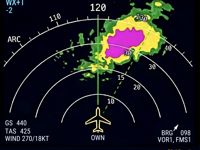
Refer to figure.
The range of TURB mode is limited to (1) _____ NM. The EFIS is displaying the level of (2) _____. The magenta represents detection of (3) _____.
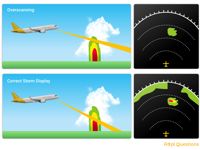
Refer to figure.
WX+T (Weather + Turbulence) mode enhances a standard weather radar display by overlaying turbulence information on the ND. In this mode, turbulence is shown in magenta.
Turbulence detection is based on the Doppler effect, which measures changes in the velocity of precipitation particles (e.g. raindrops). If these particles are moving irregularly due to turbulence, the returned radar signal is Doppler-shifted, allowing the system to identify turbulent areas.
However, this method requires precipitation particles to reflect the radar signal. Therefore, turbulence can only be detected within precipitation (wet turbulence), and Clear Air Turbulence (CAT) cannot be detected.
(1) Range – 40 NM
TURB mode operates over a limited range of approximately 40 NM. This is because turbulence detection uses the Doppler principle, which requires a strong and reliable return signal. At greater distances, the signal becomes too weak for accurate turbulence assessment.
(2) 8000 ft below
With a tilt of −2° and a range of approximately 40 NM, the center of the radar beam is directed below the aircraft. Using the 1-in-60 rule:
- 1 NM = 6076 ft ≈ 6000 ft
- 40 NM ≈ 40 × 6000 ft ≈ 240 000 ft
- Height per degree = 240 000 / 60 = 4000 ft
- For 2°: 4000 × 2 = 8000 ft
→ Therefore, the radar beam is centered approximately 8000 ft below the aircraft.
Tilt is used to ensure the radar beam intersects the most reflective part of the cloud (high liquid water content), as at higher altitudes the cloud mainly consists of ice crystals, which produce much weaker returns.
(3) Wet turbulence
The magenta areas indicate turbulence within precipitation (wet turbulence).
Doppler weather radar detects turbulence by measuring variations in the velocity of water droplets. Therefore:
- It can detect turbulence inside clouds/precipitation (e.g. inside CB)
- It cannot detect clear air turbulence (CAT), since no particles are present to reflect the radar signal
In summary, TURB mode is a short-range (up to 40 NM) Doppler function that highlights turbulence within precipitation (shown in magenta) and does not detect CAT. With a tilt of −2° at this range, the radar beam is directed below the aircraft (approximately 8000 ft).
Your Notes (not visible to others)
This question has appeared on the real examination, you can find the related countries below.
-
United Kingdom19


 Use Keyboard Shortcuts
