

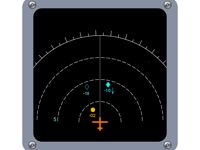
Refer to figure.
On the display device of the TCAS 2 (Traffic Collision Avoidance System), you see a solid cyan diamond. What does this represent?
Refer to figures.
EASA learning objective 022.12.10.01.17 states: ' List and interpret the following information available from TCAS: the different possible statuses of a detected aircraft: ‘other’, ‘proximate’, ‘intruder’; the appropriate graphic symbols and their position on the horizontal display; different aural warnings.'
TCAS 2 systems give visual displays of traffic around an aircraft categorised by their threat level as follows:
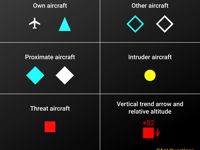
- Other Traffic - Traffic that is further away than 6 nm or not within 1200 ft of your altitude is represented by a hollow white or blue (cyan) diamond.
- Proximate Traffic - Traffic that is within 6 nm horizontally and 1200 ft vertically is represented by a solid white or blue (cyan) diamond.
- Traffic Advisory (TA) - Potentially conflicting traffic is represented by an amber of yellow circle generated 20 - 48 seconds before the closest point of approach (CPA).
- Resolution Advisory (RA) - Collision avoidance manoeuvre required in the vertical plane, represented by a red square and generated 15 -35 seconds before CPA.
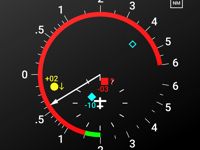
If the traffic is equipped with a Mode C altitude encoding transponder the relative altitude is also displayed alongside the symbol. For example “-10” means 1000 ft below and “-02” means 200 ft below. An arrow will point up or down, if the intruders vertical speed is more then 500 ft/min.
These TCAS symbols are either displayed on an electronic vertical speed indicator (EVSI) or the navigation display (ND) in an EFIS equipped aircraft. The type of equipment determines the colour used, typically an EVSI will use blue (cyan) diamonds and amber TA circles, whereas a ND will use white diamonds and yellow TA circles.
Proximate traffic, within 6 NM and 1200 ft vertically --> CORRECT. A solid cyan (blue) diamond represent proximate traffic within 6 nm and 1200 ft.
Other traffic within 5 NM and 1000 ft vertically --> INCORRECT. Other traffic is represented by a hollow diamond, either cyan or white and has a greater separation than 6 nm or 1200 ft.
Other traffic within 5 NM and 2700 ft vertically --> INCORRECT. Other traffic is represented by a hollow diamond, either cyan or white and has a greater separation than 6 nm or 1200 ft.
Traffic alert within 35-45 seconds from the first encounter with the traffic --> INCORRECT. Traffic alerts are represented by an amber or yellow circle.
Your Notes (not visible to others)
This question has appeared on the real examination, you can find the related countries below.
-
Greece11
-
France9
-
Austro Control6
-
Germany5
-
Italy5
-
Portugal4
-
Romania4
-
Poland3
-
Spain3
-
Czech Republic2
-
Finland2
-
Norway2
-
Lithuania1
-
Malta1
-
Switzerland1


 Use Keyboard Shortcuts
