1 / 20

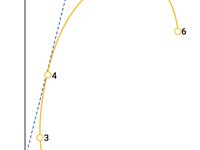
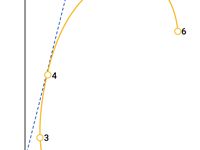
Refer to figure.
Which point on the aerofoil is represented by number 1?

  • A

    Center of pressure.

  • B

    Separation point.

  • C

    Transition point.

  • D

    Stagnation point.

Refer to figure. 
Let's explore each of these terms related to aircraft wings:

  1. Stagnation Point: The stagnation point is a specific point on the wing's surface where the airflow velocity is momentarily reduced to zero due to the pressure buildup caused by the wing's forward motion. At this point, the airflow changes direction, splitting into two streams-one flowing over the upper surface and the other flowing along the lower surface of the wing. The stagnation point is typically located at the leading edge of the wing.
  2. Upper Surface Transition Point: The transition point refers to the location on the wing's surface where the boundary layer changes from laminar flow to turbulent flow. In laminar flow, air flows smoothly and in parallel layers along the wing's surface, while in turbulent flow, the air moves chaotically, causing more mixing and energy loss. The transition point allows fast flowing air from the free stream to energise the boundary layer, so whilst the skin friction drag is higher because of the turbulent mixing, the boundary layer has more energy to remain “stuck to the wing” for longer.
  3. Lower Surface Transition Point: The lower surface equivalent of the above.
  4. Separation Point: The separation point is where the boundary layer detaches or separates from the wing's surface, disrupting the smooth flow of air over the wing. This separation typically occurs when the angle of attack exceeds a certain critical value, leading to flow separation and a decrease in lift generation. Separation points are crucial in understanding stall behavior, where the wing loses lift due to excessive angle of attack or other factors.

The “boundary layer” is a complex topic, but put simply, it is the layer of air that exists between the wing (not moving) and the freestream airflow (moving at free stream velocity). Because each air particle interacts with the other nearby air particles (we call this viscosity), this fast "freestream" airflow does not flow directly along the wing surface. The particles of air that are actually touching the surface of the wing are stationary, the next particle up has a small amount of movement, the next particle up has a bit more movement, etc., and there is an increasing amount of airflow in each subsequent particle, moving away from the wing, eventually reaching the same speed as the freestream flow. We call this the boundary layer. It can be laminar or turbulent.

Your Notes (not visible to others)


This question has appeared on the real examination, you can find the related countries below.

  • Austro Control
    2
  • Iceland
    1
  • Romania
    1