When to Use the Only Real Exam and Last Real Exam Filters
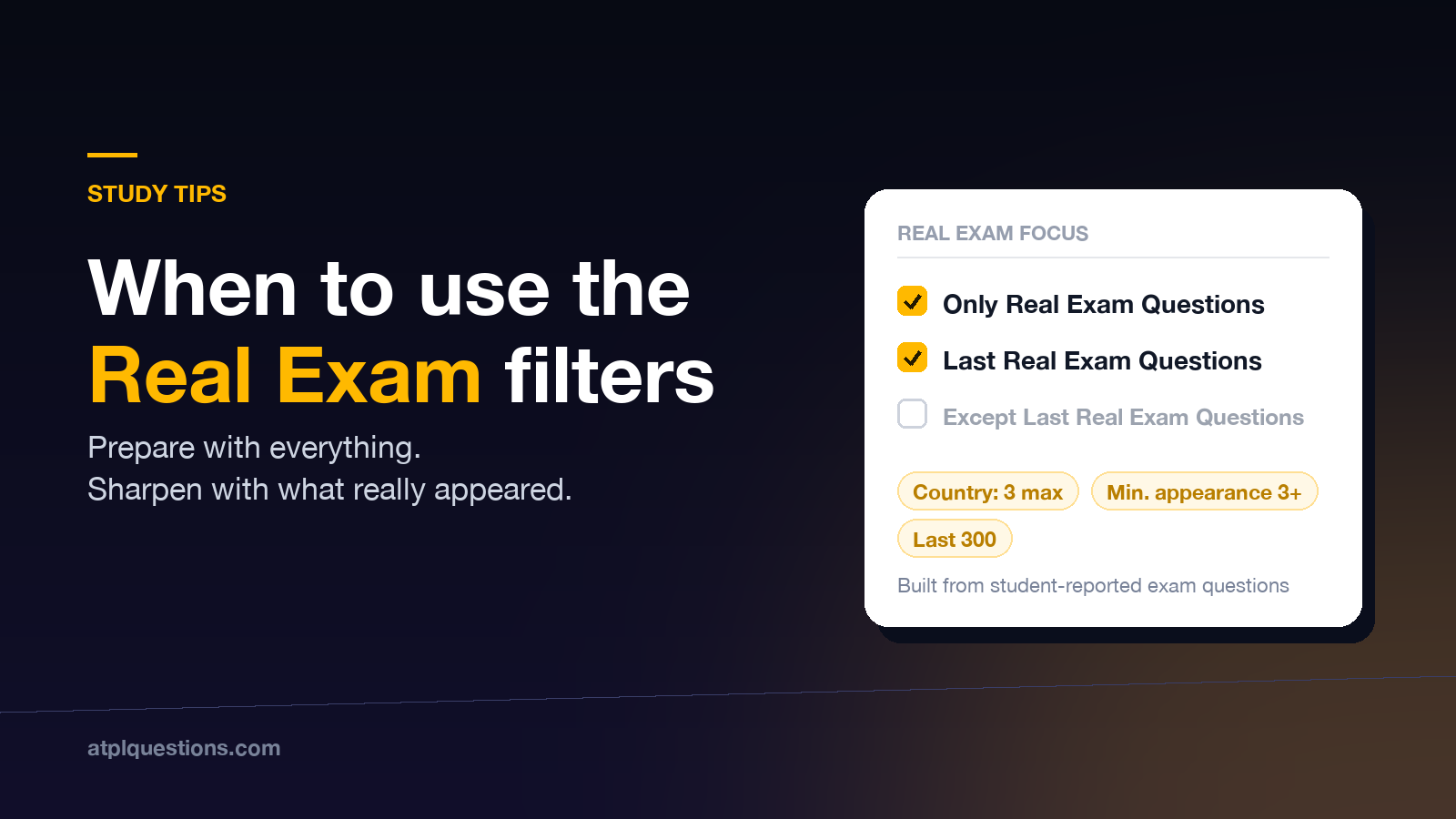
Two filters in the New Test screen get more questions from students than anything else: Only Real Exam Questions and Last Real Exam Questions. Both are powerful. Both are also the fastest way to walk into an exam underprepared if you use them at the wrong moment.
Here is what they actually contain, and when they belong in your study plan.
Where these questions come from
Neither filter is a secret list produced by us. Both are built from real exam markings — reports made by students who sat an official examination and, afterwards, came back to the platform to mark the questions they had seen.
Each marking carries the authority and country of the exam it came from, and the date it was reported. Markings are reviewed before they count: only approved markings enter the pool. That review is the reason the pool stays useful instead of turning into noise.
This is a community effort in the most literal sense. The filter you use before your exam exists because someone who sat that exam before you took the time to report what they saw. If you use it, pass it on afterwards — mark your own exam questions so the next student gets the same advantage.
You can see everything you have reported, and whether it has been approved yet, on the My Real Exam Markings page in your dashboard.
What each filter gives you
Only Real Exam Questions builds a test from every question in the subject that has been reported as seen in an official examination. It is the whole verified pool, not a recent slice. Two optional settings shape it:
- Country — select up to three countries to keep the test close to the authority you will be examined by.
- Min. Appearance — "3 and above", for example, keeps only questions reported at least three times. Raise it when you want the questions that keep coming back rather than one-off reports.
Last Real Exam Questions takes the same pool and cuts it by recency: the most recently reported questions first. You choose how many — from 100 up to 1000 — and you can narrow it by country as well. This is the closest thing available to "what is being asked right now".
There is also a third, less known option: Except Last Real Exam Questions. It is the exact inverse — it removes the most recent N reported questions and shows you everything else. It exists for one specific job, and we will come back to it below. (soon will be available)
Why these filters are not a study plan
The temptation is obvious: if these are the questions that appear in exams, why study anything else?
Because the pool tells you what has been asked, not what will be asked. Question banks at the authorities rotate. A subject you prepared exclusively from recent markings leaves you with no defence the moment an examiner pulls a question that nobody has reported yet — and you will not even recognise the topic, because you never studied it.
There is a second, quieter problem. Studying a narrow pool over and over teaches you to recognise answers, not to understand theory. You start remembering that the third option looked right last time. That works until the numbers in the question change slightly, and then it fails completely.
Real exam markings are an advantage layer. They sit on top of proper preparation. They do not replace it.
The sequence that actually works
Treat your preparation for each subject as three phases.
Phase 1 — Cover everything (no real exam filters). Work through the full question bank for the subject, reading the explanation of every question you get wrong. Your goal here is coverage and understanding: every learning objective touched, every weak topic identified. Use the flags and notes as you go, and let the reports tell you which topics are still soft.
Phase 2 — Fix the weak topics (still no real exam filters). Use the incorrectly answered and flagged filters, plus your subject-area performance in the reports, to attack the three or four topics that keep costing you points. Finish this phase when your simulations are comfortably above the pass mark — not barely at it.
Phase 3 — The final week: switch the real exam filters on. Now the pool earns its place. In the last seven to ten days before your sitting:
- Run Last Real Exam Questions with your country selected — start at 100 or 200 questions to see what is current, then widen it.
- Run Only Real Exam Questions with Min. Appearance at 2 or 3 for the questions that appear again and again.
- Finish with two full exam simulations under time pressure, with no filters at all, to confirm nothing slipped.
The order matters more than the settings. Learning every possible question first and then seeing the ones that genuinely came up is what puts you a step ahead on exam day. Doing it in reverse just narrows your knowledge and gives you false confidence.
Two situations where the filters change shape
You are resitting a subject. Do not start again from the full bank. Begin with Only Real Exam Questions filtered to your country to rebuild the exam-shaped picture, then use your incorrectly answered questions to close the specific gaps that failed you. Keep one full simulation for the last day.
You have already drilled the recent pool to death. This is what Except Last Real Exam Questions is for. Exclude the last 300 or 500 reported questions and study only what remains — it forces you back into the material your recognition memory has been letting you skip. It is the single best way to find out whether you actually know the subject or just know the pool.
A short checklist
- Do not build your whole preparation on real exam filters — cover the full bank first.
- Select your country: an exam pool from another authority is interesting, not relevant.
- Use Min. Appearance to separate repeat questions from single reports.
- Bring the filters in during the final week, not in week one.
- Always finish with an unfiltered, timed simulation.
- After your exam, report the questions you saw. The filter only works because students before you did exactly that.
Prepare with everything, then sharpen with what really appeared. That is the whole method.