How to Pass ATPL Air Law on Your First Attempt
Ask ten students which ATPL subject they are least worried about and most of them will say Air Law. No formulas, no CAP 697, no wind triangles. Then the result comes in and it is 68%. Air Law is one of the subjects students most often have to resit, and almost always for the same reason: they studied it like a reading subject, while the exam tests it like a numbers subject.
This guide is the plan our instructor team gives students who want to pass 010 Air Law in one sitting. It takes three weeks at a sustainable pace, and it is built around questions from day one.
What the Air Law exam actually tests
The syllabus reads like a legal text: the Chicago Convention and the ICAO Annexes, Part-FCL licensing, the Rules of the Air (SERA), air traffic services, airspace classification, PANS-OPS procedures, aerodromes, search and rescue, security and accident investigation.
The questions, however, rarely ask you to explain a principle. They ask you for the exact value:
- How long a licence, a medical certificate or a rating is valid, and for which age group.
- Which airspace class gives VFR traffic a separation service, and which gives only traffic information.
- The minimum semi-circular cruising level for a given track, and the transition between flight levels and altitudes.
- Which Annex deals with which subject, and which body is responsible for what.
- Distances, times and heights in approach procedures, signals and light gun instructions.
Every one of those is a precise fact with three plausible wrong neighbours sitting next to it in the answer options. That is why "I understand Air Law" and "I can pass Air Law" are two different things.
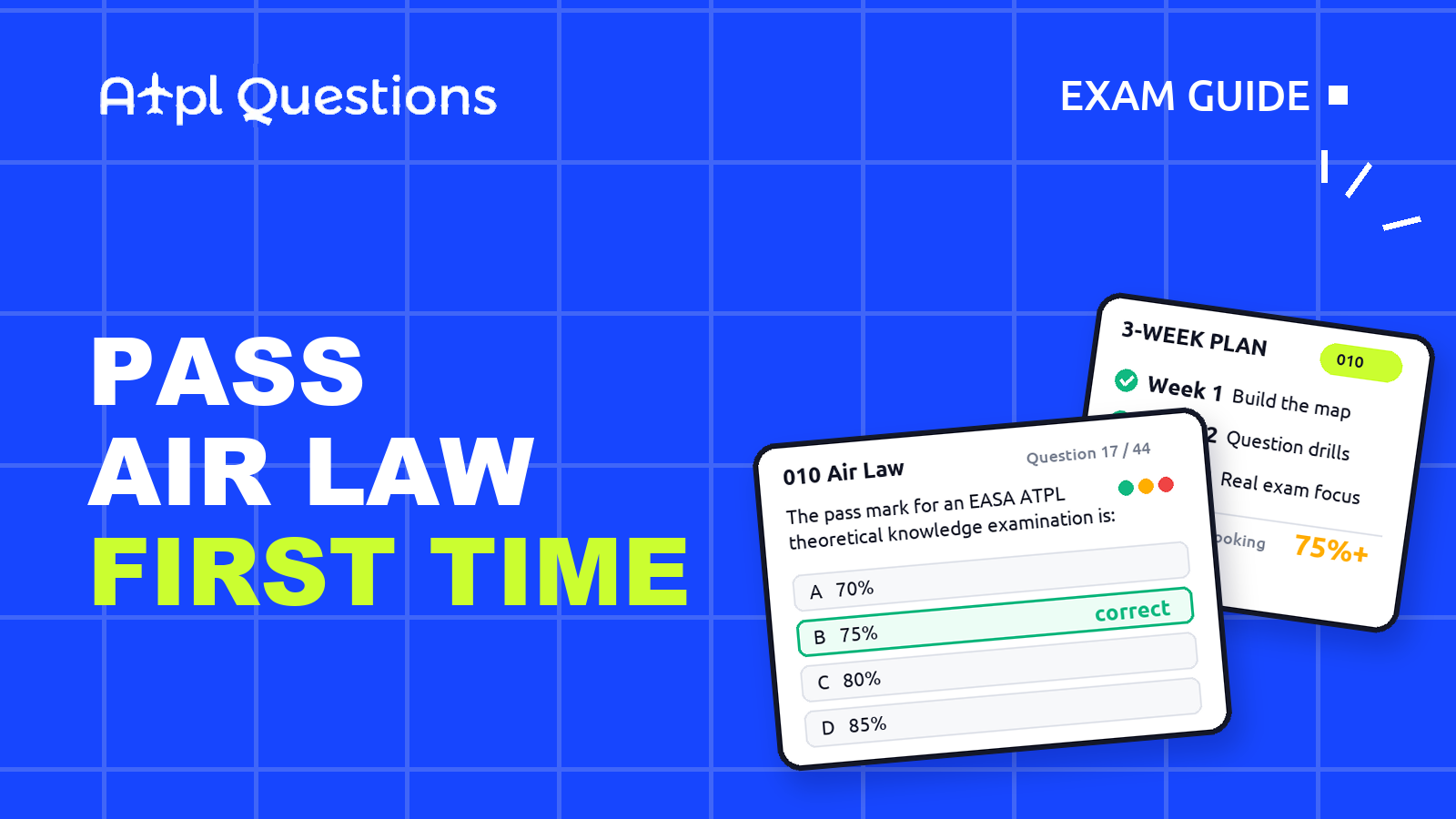
The exam is around 44 questions in an hour, with a 75% pass mark. That leaves room for about ten mistakes. Most students who fail lose those ten marks on numbers they had read but never actively recalled.
Week 1 — Build the map
Spend the first week getting the structure into your head. Read your course material once, without taking detailed notes and without trying to memorise every figure. The goal is to know where things live: which Annex, which Part, which chapter.
Two things are worth doing deliberately in week 1:
- Draw the airspace table yourself. Classes A to G across the top; separation, traffic information, clearance required, speed limits and VMC minima down the side. Fill it in from memory at the end of the week. You will use this table in the exam more than anything else.
- Start a numbers sheet. One page, nothing but values: validity periods, ages, distances, times. Add to it every day for the next three weeks.
Then, at the end of the week, do one Study test of 40–50 questions across the whole subject. Do not worry about the score. It is your baseline, and it tells you which chapters felt like a foreign language.
Week 2 — Switch to question-first study
This is where most students go wrong: they keep reading. From week 2, reading is only what you do after a question has shown you a gap.
Aim for 60–80 questions a day in Study mode, one chapter at a time. For every question you get wrong, open the Explanation tab and read it properly. If it references a rule or a table, go back to your notes for that one point only, then move on.
Use the tools in the question panel to make the next pass faster:
- Colour flags. Red for questions you got wrong and did not understand, yellow for ones you guessed, green for the ones you want to see once more before the exam. Flags stay with the question, so at the end of the week you can create a test from Red flagged only.
- Notes. If a wrong answer came from a specific confusion ("Annex 2 vs SERA", "medical validity above 40"), write it on the question. The note comes back with the question next time.
- Stats tab. It shows how many times you have met the question and how often you got it right, next to the rate at which all students answer it correctly at first attempt. A question that the community gets right 85% of the time and you keep missing is a personal gap, not a hard question. Those go on the numbers sheet.
After each finished test, read the AI Test Analysis at the top of the report. It groups your incorrect questions by sub-subject and tells you which two or three areas are costing you marks. Create your next test from those areas with Wrongly answered, and keep going until the analysis stops naming them.
By the end of week 2 you should be scoring 70–80% on fresh Study tests. If you are below that, extend week 2 rather than moving on. Air Law does not reward moving on.
Week 3 — Real exam focus
The final week is about exam conditions and exam content.
Real exam questions first. Students on ATPL Questions mark the questions they met in their actual sitting, and the Real Exam Questions filter gives you that set for your exam authority. Start the week with the most recent ones: tick Last Real Exam Questions, pick a number such as 300 and choose your authority. These are the questions that have appeared most recently, so they are the ones most worth knowing cold.
Then the rest of the bank. Once you are confident on the recent set, use Except Last Real Exam Questions with the same number. It shows you everything else, so you are not caught by a question that simply has not come up in a while.
Finish with two full exam simulations. Exam mode, 44 questions, one hour, no explanations until you finish. Treat them like the real thing: no notes, no pausing, and the timer visible. If both come in at 75% or more, book your sitting. If one comes in lower, spend two more days on the sub-subjects named in its Test Analysis and run one more simulation.
The numbers that decide the exam
These are the areas where most first-time marks are lost. If your numbers sheet does not cover them, it is not finished:
- Licences and medicals. Validity periods and the age limits that change them. Minimum ages for each licence. What a Class 1 medical requires for a commercial pilot above a certain age.
- Airspace classes. Who gets separated from whom, where a clearance is required, and the speed limit below FL100 and in which classes.
- Rules of the Air. Right-of-way, light signals from the tower, semi-circular cruising levels, and the minimum heights over congested areas and open country.
- Procedures. Transition altitude, layer and level; holding entry sectors; approach segment names and what each one starts at.
- Who does what. Which ICAO Annex covers which subject. The difference between a standard, a recommended practice and a PANS document.
- Emergencies and interception. Transponder codes, the interception signals and the correct response to each.
Do not try to learn these from a list on the night before. Learn them by meeting them in questions, getting some wrong, and seeing them again three days later.
Three habits of students who pass first time
- They answer questions from week 1, not week 3. Reading feels productive; recalling is what the exam measures.
- They review every wrong answer, including the lucky right ones. A yellow flag on a guess is worth more than a green tick you did not earn.
- They book the exam when the simulations say so, not when the calendar does. Two full tests at 75%+ is the signal. Anything less, and a week more preparation is cheaper than a resit.
Ready to start week 1? Create a Study test in 010 Air Law, flag what you miss, and let the AI Test Analysis tell you where to go next. Thousands of real exam questions, marked by students who have just sat the exam you are preparing for.